
FROM PROMPT TO PRACTICE
- Luca Collina

- 2 days ago
- 4 min read
Normally we assess the usefulness of a prompt through the answer it elicits. Useful answer, effective prompt. However, prompts have another impact when used in the workplace.
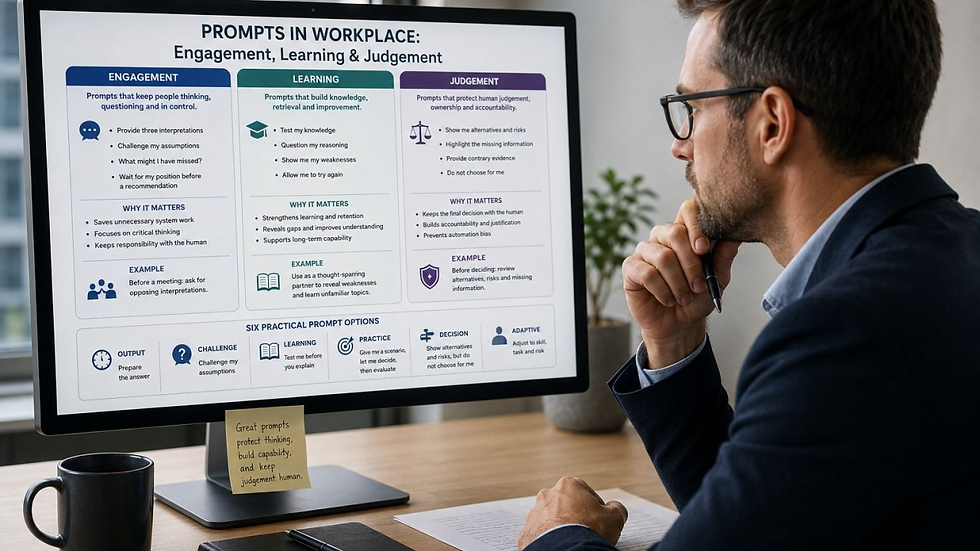
Let's take two examples. The manager could ask, "Analyse this problem and tell me what I should do." Alternatively, the manager could ask, "Provide me with three interpretations, challenge my assumptions, show me what I might have missed, and wait for my position before making a recommendation." The first creates much more system work than the second one.
Prompts and Engagement
A prompt can save people from unnecessary work, but a prompt can also take away useful thought. Frequent prompts for answers can distract the user's attention from creating a position towards assessing completed tasks. A prompt could alternatively ask the person to provide questions, alternatives, contradictions or missing evidence.
The research with 319 knowledge workers demonstrated that AI-assisted work changes the location of critical thinking. Users discussed verification, integration and task stewardship, while increased confidence in AI correlated with decreased critical-thinking efforts. The idea is to figure out which thought process should be left to the user.
Prompts and Learning
That decision also affects the user's learning. The prompt "Explain this topic" provides information. The prompt "Test my knowledge, question my reasoning, show me my weaknesses and allow me to try again" makes users retrieve, apply and improve their knowledge.
Lilli from McKinsey provides a particularly good example. The firm mentions the consultant's use of it as a thought-sparring partner to reveal weaknesses in an argument, anticipate questions and learn unfamiliar topics. 2. The important thing is not the mere possibility of getting the needed knowledge. The manner of requesting makes it possible.
Prompts and Experience
A prompt cannot substitute an experience. The reading of ten complex cases is not equivalent to taking the responsibility for one. The experience is still about action, feedback, consequences and reflection. But a prompt can enrich a person's experience. Before a meeting, a manager can request opposing interpretations. After a decision, the manager can find out which assumptions failed or what signals were missed.
Morgan Stanley provides another example of interaction. The firm says that the advisers use AI tools in their work, reviewing and adjusting the outputs before finalising them. 3. The case is not a study of the prompt design, but it shows an important principle. The assistance could be embedded into the workflow, while human interpretation and checkup remain active.
Prompts and Decision Making
The decision-making is another domain, where that distinction becomes even sharper. The prompts "What should I do?" and "What should I consider before deciding?" distribute reasoningings in different ways.
An experiment involving 758 Boston Consulting Group consultants showed that AI improved performance on tasks within its competence, but the consultants who used AI were less likely to make the right decision on tasks outside of that competence. 4 The study does not prove that one prompt style leads to better decisions. It proves that a compelling output should not be treated as the decision immediately.
The decision prompt can ask for alternatives, risks, contrary evidence, and missing information, while leaving the final choice to the manager.
Prompts and Accountability
And finally, there is another connection. When the employee asks for a recommendation, accepts it and performs actions, a human remains formally responsible, but the reasoning behind the action thins. The stronger interaction can require the user to provide his/her own initial position, test risks, challenge the output and justify the final decision.
BCG mentions that Shell changed its workflows so people keep interpreting, validating and making final decisions. There is also peer review for material outputs. Additionally, the junior staff should frame problems and test assumptions independently before applying AI tools for analysis. 5. That case moves the problem out of prompt engineering. The organisation decides what the person must keep practising and performing.
Six Practical Prompt Options
All that suggests a simple list of choices for managers. The output prompt "Prepare the answer" is useful when speed and efficiency are the major objectives. The challenge prompt "Challenge my assumptions and show me contrary evidence" engages the user. The learning prompt "Test me before you explain" requires the user to retrieve and apply knowledge. The practice prompt "Provide me with a difficult situation, let me make the decision, and then evaluate my reasoning" can be used for the preparation or during the work. The decision prompt "Show me the alternatives and risks, but do not choose for me" protects human judgement and ownership.
There is one more type of the prompt: the adaptive one. The level of assistance changes depending on the skill and the task. The junior employee needs to receive questions, guidance and feedback. An experienced manager will get more profit from challenges, contradictory evidence and unusual situations. In the risky situation the prompt could explicitly require the human's independent opinion before showing any recommendations.
So now the important question is not just, "Is it a useful prompt?" It is also asking, "What is this prompt asking the human to continue doing?"
Some prompts should just save the time. Some other prompts can protect questioning, practice, learning, judgement and responsibility. The things that people keep doing become their practice. The practice determines what people learn and eventually what they can do well without any assistance.
The prompt looks like a technical instruction. In fact, the prompt can become a part of human work design. judgement
Comments